
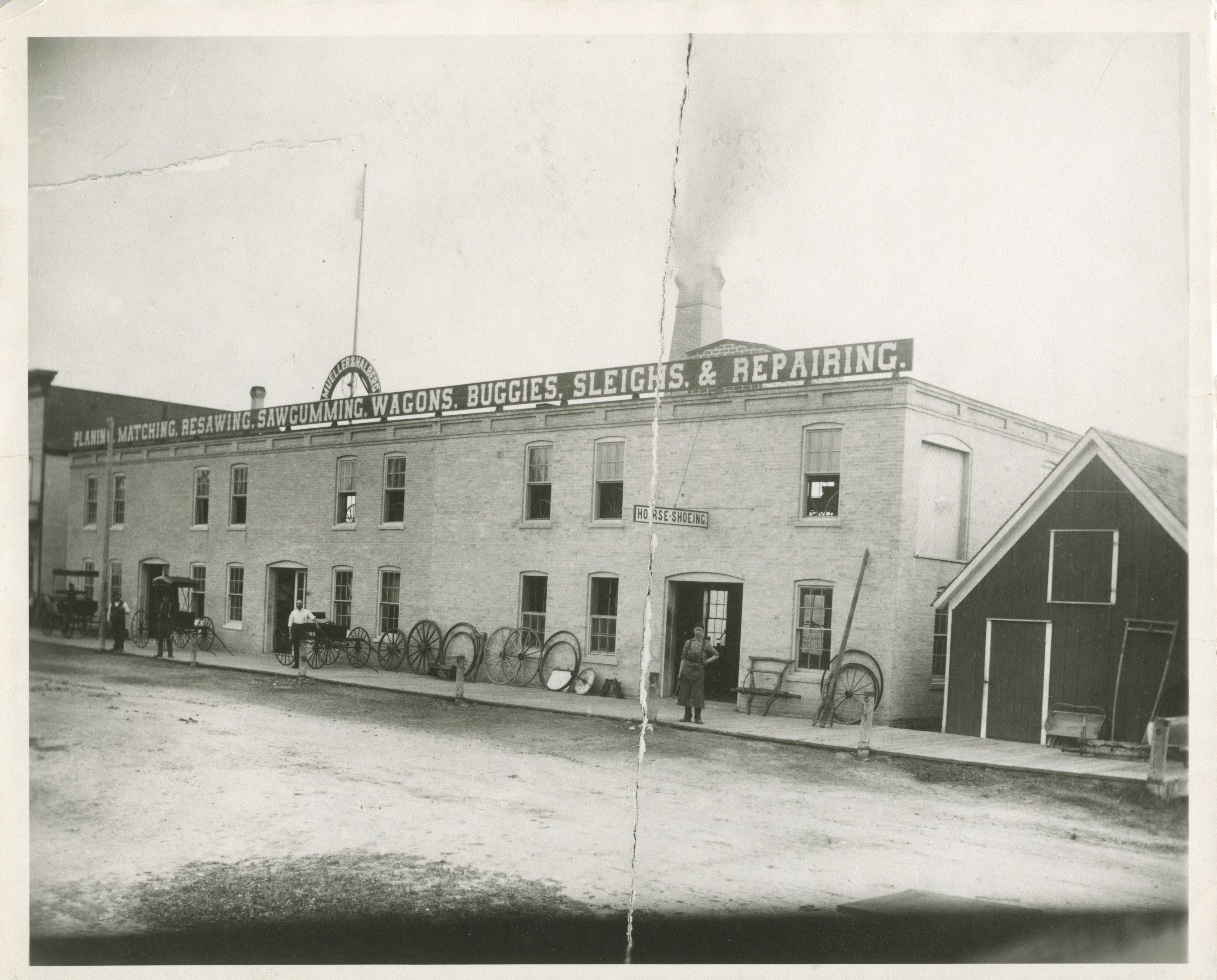


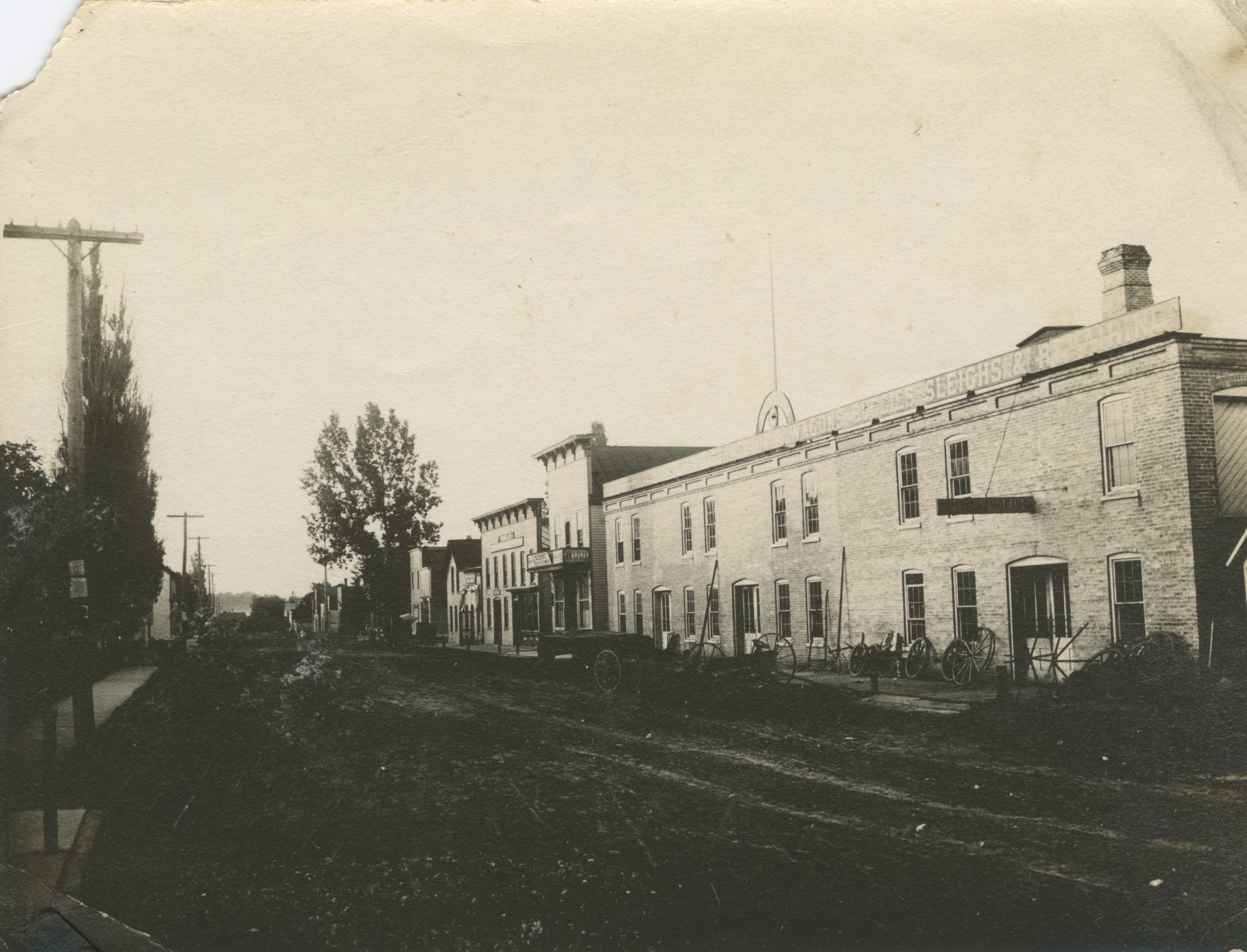
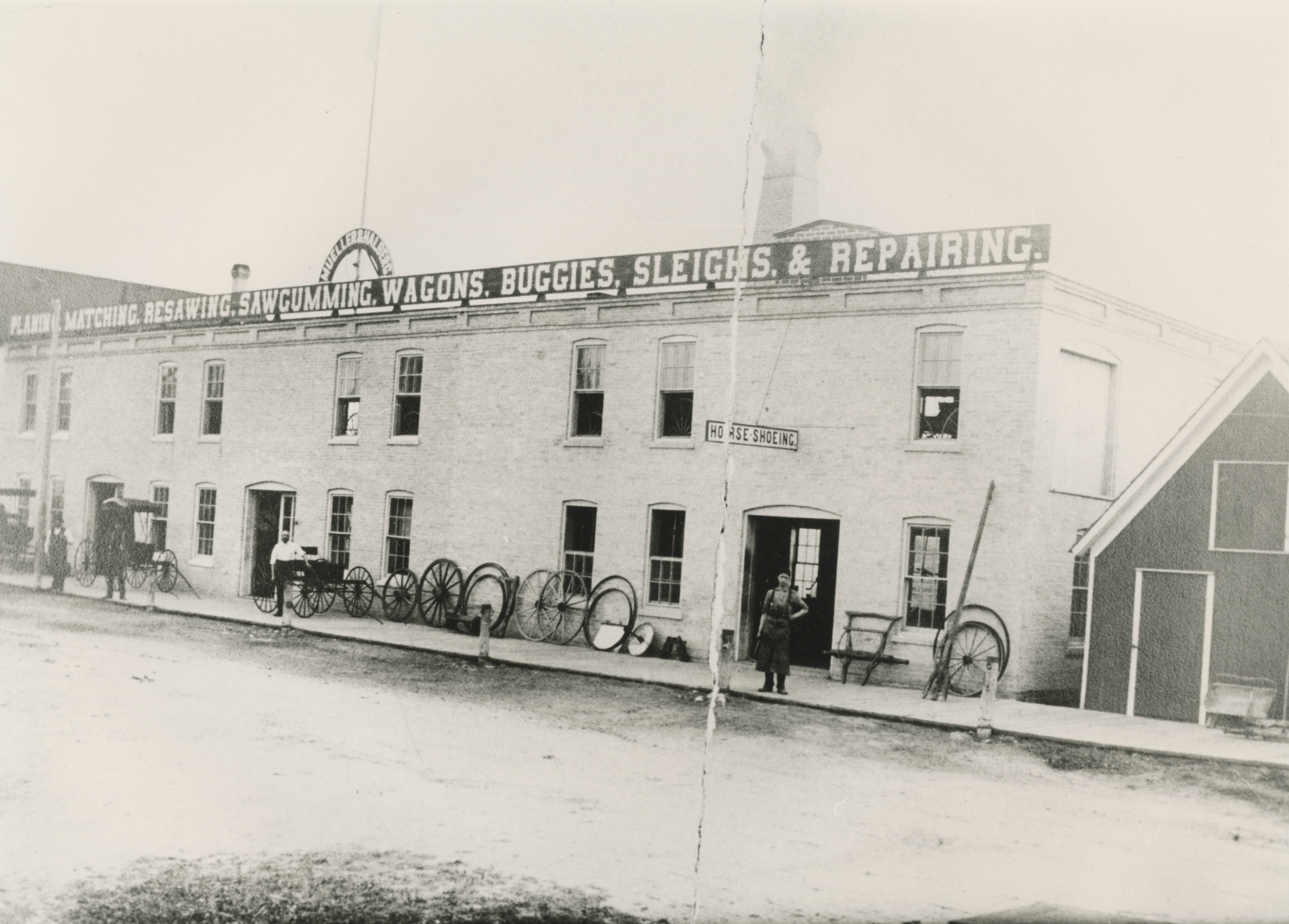
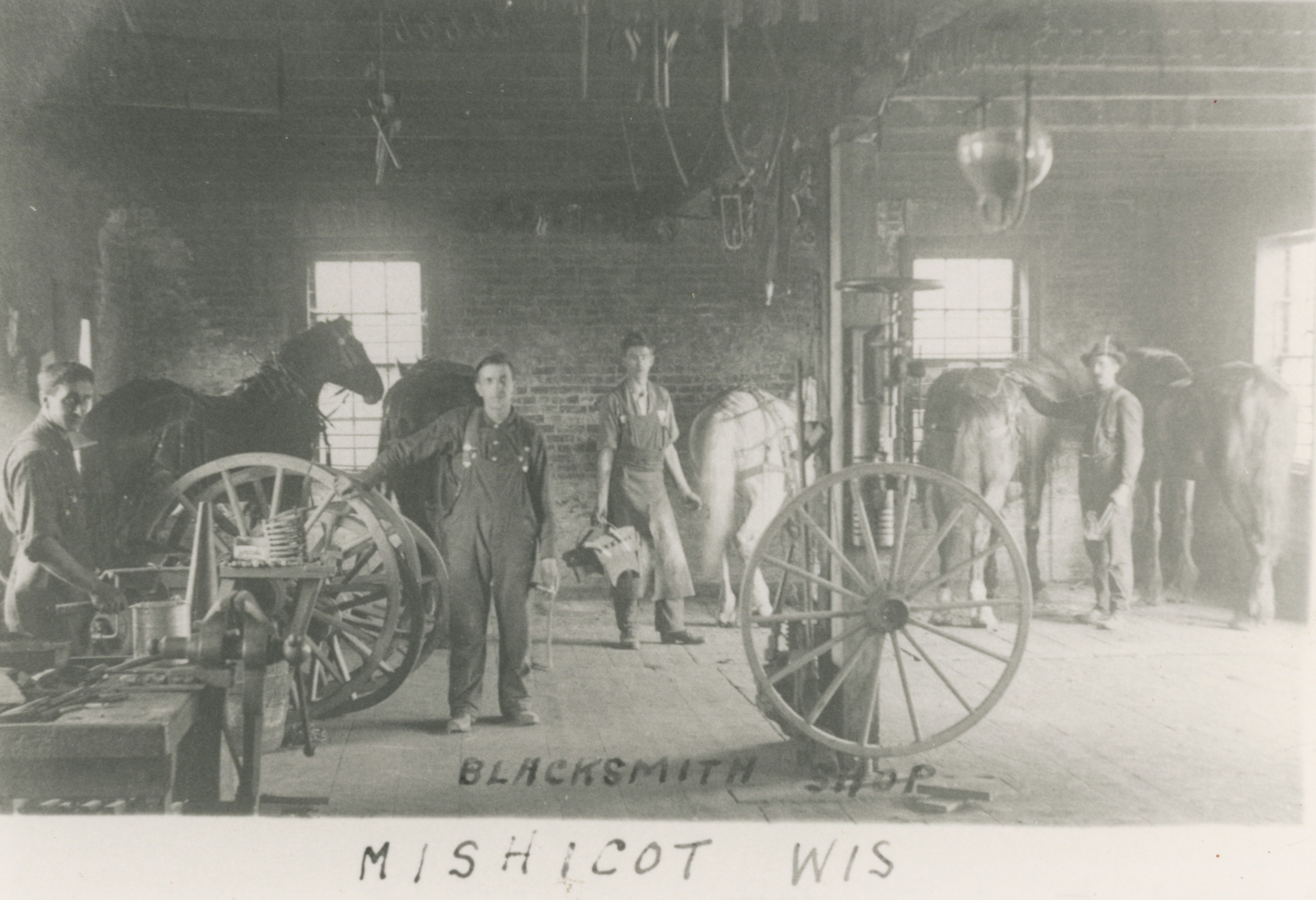
Miscellaneous photos captured in front of and inside Joseph Dufek’s Blacksmith Shop, which was located at 302 – 314 E Main Street in Mishicot, Wisconsin. On the shop were three signs. One, shaped like a wagon wheel, read, “Mueller & Halberg.” Another that ran the length of the building read, “Planing, Matching, Resawing, Sawgumming, Wagons, Buggies, Sleighs, & Repairing.” A small sign projecting from the building read, “Horse-Shoeing.”
From “Mishicot’s Meaningful Memories“:
The village blacksmith was a common sight in the formative years of any village, and Mishicot was no exception. Jim Pivonka was one of the blacksmiths and had his shop on what is now Main Street where the laundromat is today.
As the forge heated the iron the blacksmith smelted it and shaped it into useful tools. Both the forge and chimney were made of brick. Bellows were used to make the fire burn more intensely.
Anvils mounted on stumps were fastened down with iron spikes. Once the shoe was heated, it was lifted from the coals with tongs, placed on the anvil, and hammered and shaped with short strokes. To cool the shoe, it was placed in a barrel of water, and then secured on the waiting horse.
A common sight at the entrance of the blacksmith shop were iron rings. They were used for tying the waiting horses. Another common sight was a stone table with a hole in the middle. This was a base upon which were placed the wagon wheels that needed fixing.
When Joseph J. Dufek came to the area he worked with Jim Pivonka and learned the blacksmith trade. One might have thought him to have been an early apprentice. Later Joe opened his own shop on the opposite end of town, where the Magic Mirror is today.
It was customary to see a blacksmith forging shoes for horses, repairing wagon wheels, and casting things out of iron. One of Joe Dufek’s specialties was shoeing western horses. Many have said this was a very high spirited breed of horses. Often times people gathered around
the chimney in Joe’s shop to watch the swallows and exchange a little small talk.
Everyone knew Joe to be a very good- hearted man. His home was always open, and what he had he often shared with others. It has been said that Joe even had his own little adver- tising slogan. It went something like this: “Joe Dufek.. .nuf sed.”
There should be no doubt how important the blacksmith was to the people of this village.
Tags: blacksmith, mueller and halberg, joseph dufek, main street
Download high resolution copies of these items on archive.org.
Know more about these items? Contact the museum.
 Mishicot Historical Museum