
From Amerikan Národní Kalendář (1922) “Memories of Czech Settlers in America”
Translated, with parenthetical comments*, by Kryštof Ořeský in June 2024 (thank you!) Further edits and update by Michael Jindra.
Original Czech article discovered and posted on Facebook by Ron Tikalsky in February 2024.
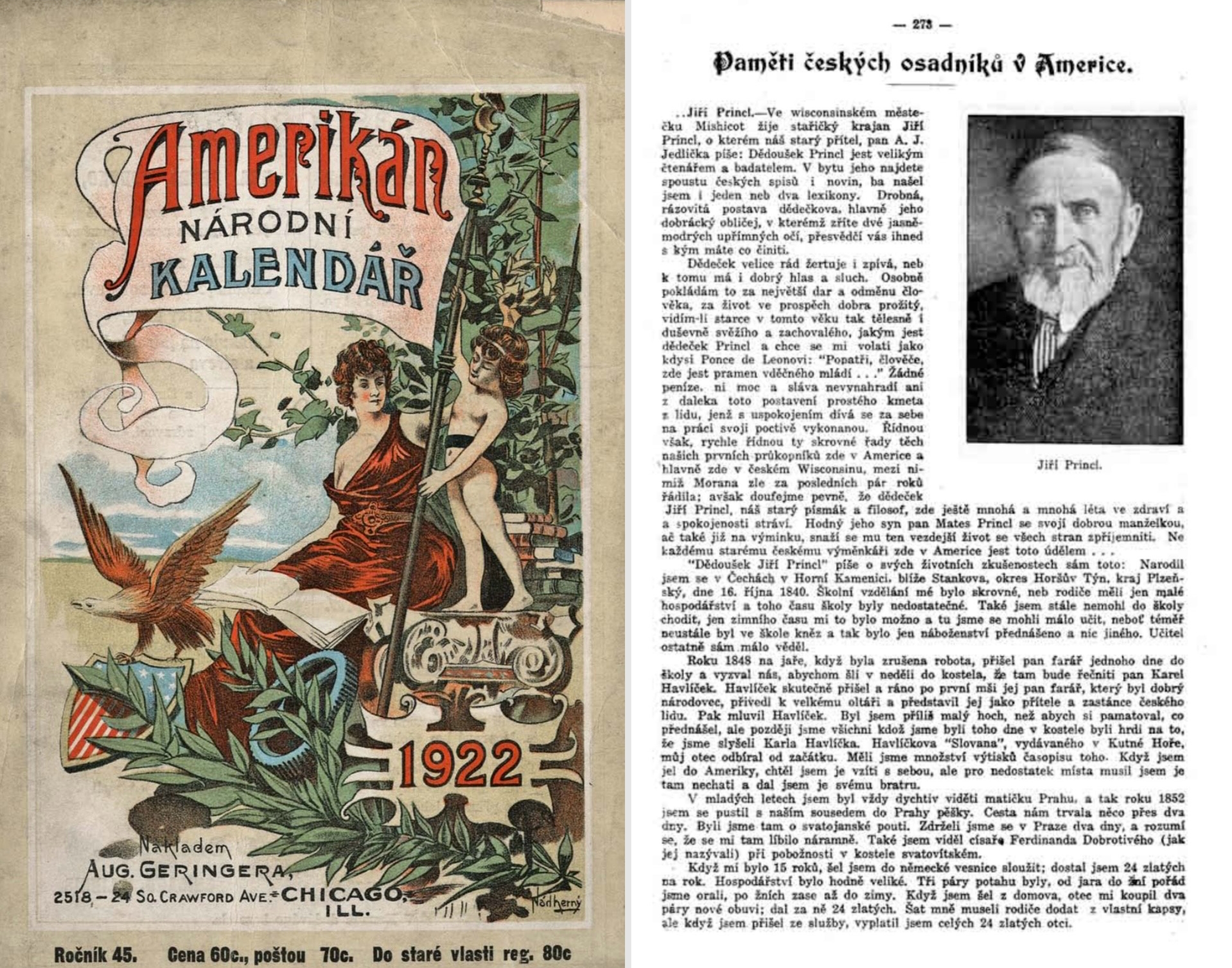
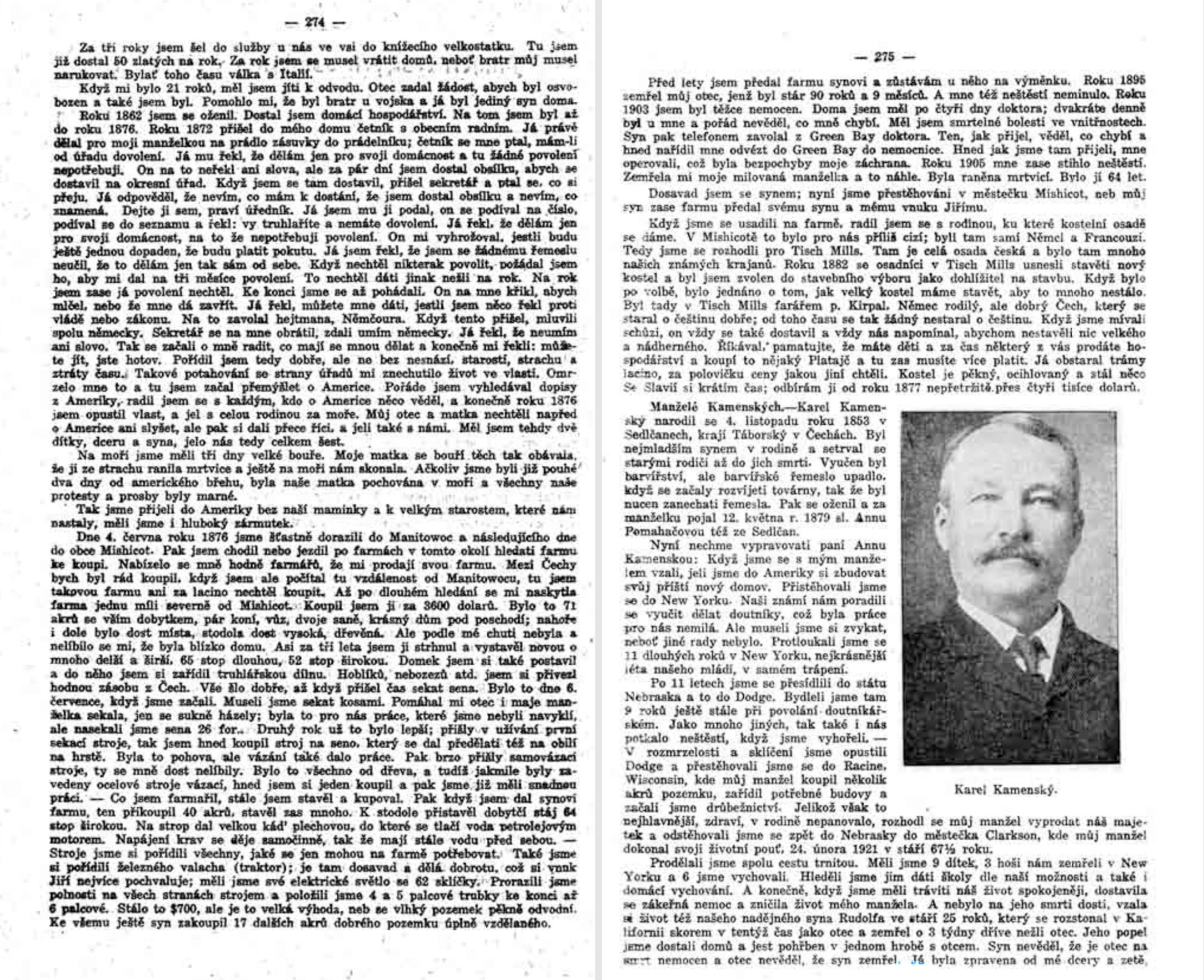
Jiří Princl – In a town called Mishicot in Wisconsin, lives an old compatriot Jiří (George) Princl, about whom our old friend, Mr. A. J. Jedlička writes: Grandfather Princl is a great reader, and a researcher. In his house, you can find plenty of Czech writings, and newspapers, but I also found two lexicons. Grandfather’s small striking figure, especially his good-natured face, in which you can see two bright blue sincere eyes, will immediately convince you who you are dealing with.
Grandpa really likes to joke, and sing, because he also has a good voice, and hearing. Personally, I consider it as his greatest gift, and a personal reward for a life that he lived for a favor of good. When I see an old man at this age as physically and mentally fresh, and well preserved, like Grandpa Princl is, I want to call him like Ponce de Leon said: “Watch It, man, here is the fountain of grateful youth.” No money, neither power nor fame cannot even remotely compensate for this position of a simple peasant from among the people, who looks behind him with satisfaction at his work done. However, these meager ranks of those first pioneers of ours here in America and especially here in Czech Wisconsin, among whom the Morana [grim reaper] has been raging badly for the past few years, are thinning out, thinning out fast, but let’s hope firmly that grandfather Jiří Princl, our old writer and philosopher will spend many, many years in health and contentment. His good son Mates Princl with his good wife, even when Jiří Princl is living in “výminek” (a small part of a house, maybe one or two rooms, where mostly old people live, with its own kitchen)* are trying to make his everyday life pleasant from all sides. It for sure does not apply to every old person that lives in a“výminek.”
Grandfather Princl writes here about his life experiences:
I was born in Bohemia (a main part of the present-day Czech Republic)* in Horní Kamenice, which is close to Stankov, in the “okres” (“okres” is similar to county)* Horšův Týn (“okres” Horšův Týn no longer exists, in 1960 “okres” Horšův Týn merged with “okres” Domažlice)*, Plzeň (Pilsen, where Pilsner Beer is from)* district on October 16 1840. My school education was really modest, because my parents had only a small farm, and back then the schools were insufficient. I also could not go to school all the time, only in the winter time it was possible, and there, we were able to study just a little bit, because there was a priest, so only theology was taught, nothing else. After all, the teacher didn’t know much.
In spring 1848, when the corvee was cancelled [unpaid labor serfs owed to the feudal lord; the feudal system was abolished that year], the priest came one day, that we have to go to church on Sunday, because Mr. Karel Havlíček will have a speech there. Havlíček actually came, and in the morning after the first service, the priest, who was a good nationalist, brought Mr. Havlíček in, in front of the altar, and introduced him as a big advocate of the Czech people. Then Mr. Havlíček was speaking. I was too young to remember what he was talking about, but later, all of us, who went to the church that day, were proud that we could hear Mr. Havlíček speaking. My father subscribed to Havlíček’s “Slovan”, published in Kutná Hora, from the very beginning. We had many copies of this magazine. When I went to America, I wanted to take them with me, but since I didn’t have enough space, I had to give them to my brother.
In my younger years, I was always eager to see the mother Prague, so in 1852, me and my neighbor decided to walk to Prague. The walk took us a little over two days. I was there over the St. John’s pilgrimage. We stayed in Prague for two days, and I really enjoyed it. I also saw the Emperor Ferdinand the Benevolent (that is how they called him) in the Saint Vitus church in devotion.
When I was 15 years old, I went to a German village to serve. I got 24 gold coins per year. The farm was very large. There were 3 pairs of covers, from spring till harvest, we were still plowing, after harvest, all the way till winter. When I left home, my father bought me two pairs of new shoes, he spent 24 golden coins on them. My parents had to buy the clothes for me using their own money, but when I came back home, I paid the 24 golden coins back to my father.
In 3 years, I went to serve to the princely estate in our village. Here I got 50 golden coins a year. In a year, I had to come back home, because my brother had to enlist. It was a war with Italy back then.
When I was 21 years old, I had to go to the draft, [but] my father requested that I should be freed, and I was. The thing that helped me was that my brother was in the army, and I was the only son home.
In 1862, I got married. I got the home farm. I was there till 1876. In 1862, a policeman came to my house with the municipal councilor. I was just making drawers for clothes for my wife. The policeman asked if I have a permit to do this, so I told him that I don’t need a permit for this, because it is just for my personal use. He didn’t say a word about it, but in a few days, I received a summons to appear at the district office. When I got there, the secretary came and asked what I wanted. I replied that I don’t know what I have to do, that I received a parcel and I don’t know what it means. Put it here, says the councilor. I handed it to him, he looked at the number, looked at the list and said: you are a carpenter and you don’t have a permit. I said that I only do it only for my household, that I don’t need a permit. He threatened me to pay a fine if I was caught again. I said that I did never learn how to do carpentry, that I just do it on my own. When he didn’t want to give permission in any way, I asked him to give me permission for three months. He didn’t want to give it any other way than for a year. I didn’t want permission for a year. Towards the end we had a fight. He yelled at me to shut up or he would have put me in jail. I said, you can put me in jail if I said anything against the government or the law. He then called the governor. The governor was German. When he came, they were speaking German. The secretary turned to me to see if I could speak German. I said I couldn’t speak a word. They started discussing about me, what to do with me and finally they told me: you can go, you’re good. I did well, but not without trouble, worry, fear, and loss of time. This kind of problems with authorities disgusted me with life in my homeland. I was sick of it, and that’s when I started thinking about America. I kept looking for letters from America, I consulted everyone who knew anything about America, and finally in 1876 I left my homeland and went overseas with my whole family. My father and mother didn’t even want to hear America at first, but then they agreed, and they also went with us. I had two children at the time, a daughter and a son, so there were six of us.
We had three days of big storm while traveling overseas. My mother was so afraid of those storms that she suffered a stroke from fear and died while we were traveling overseas. Although we were only two days from the American shore, our mother was buried at sea, and all our protests and requests were in vain.
We came to America without our mother, and in addition to the great worries we had, we also had a deep sorrow.
On the 4th of June, 1876, we happily arrived at Manitowoc, and the next day at Mishicot. Then I would walk or ride around the farms in that area looking for a farm to buy. Many farmers offered to sell me their farms. I would like to buy among the Czech people, but when I counted the distance from Manitowoc, I didn’t want to buy a farm like that for cheap. It was only after much searching that I came across a farm one mile north of Mishicot. I bought it for $3600. It was seventy-one acres with all the cattle, a couple of horses, a wagon, two sleighs, a fine house below; there was plenty of space above and below, the barn was quite tall and wooden. But it wasn’t to my taste and I didn’t like that it was close to home. In about three years I tore it down and built a new one much longer and wider, 65 feet long, 52 feet wide. I also built a house and set up a carpentry workshop in it. I brought a good supply of planers, chisels, etc. from Bohemia. Everything went well until it was time to cut the hay. It was on the 6th of July when we started. We had to cut with scythes. My father and my wife helped me cut, it was work for us that we were not used to, but we chopped hay to 26 loads. The second year it was better; the first mowing machines came into use, so I immediately bought a hay machine, which could also be converted to a grain machine. It was a really comfortable, but the tying also took some work. Then self-tying machines came soon, I didn’t like them enough. It was all made of wood, so as soon as steel binding machines were introduced, I immediately bought one and then we had an easy job. – When I was farming, I was still building and buying. Then when I gave the farm to my son, he bought another 40 acres, built a lot more. He added a cattle stable, 64 feet wide to the barn. He put a large tin tub on the ceiling, into which water is pumped with a kerosene motor. Cows are fed automatically, so they always have water in front of them. We bought all the machines that could be needed on the farm. We also acquired a tractor [direct translation is “iron gelding”]; it is still there and doing good, which Mr. Jiří Vank praises the most; we had our electric light with 62 bulbs. We drilled field pits on all sides of our fields and we laid 4 and 5 inch pipes towards the end and 6 inch pipes. It cost $700, but it’s a big advantage because the wet land drains nicely. To top it all, my son bought 17 more acres of good land fully improved.
I passed the farm on to my son years ago and I am staying with him on an exchange basis. In 1895, my father died, who was 90 years and 9 months old. And misfortune did not escape me either. In 1903 I was seriously ill. I had a doctor at home for four days; he was with me twice a day and still didn’t know what I was missing. I had deathly pains in my bowels. My son then called a doctor from Green Bay on the phone. When he arrived, he knew what was missing and immediately ordered me to be taken to Green Bay to the hospital. As soon as we got there, he operated on me, which was undoubtedly my salvation. In 1905, misfortune befell me again. My beloved wife died suddenly. She suffered a stroke. She was 64 years old. So far, I am with my son; now we are moved to the town of Mishicot, because my son again passed the farm to his son and my grandson Jiří.
When we settled on the farm, I consulted with my family about which church settlement we would go to. It was too foreign to us in Mishicot; only the German and the French were there. We decided on Tisch Mills. The entire settlement is Czech there and many of our well-known compatriots were there. In 1882 the settlers at Tisch Mills decided to build a new church, and I was elected to the building committee as supervisor of the building. When the election was over, it was discussed how big a church we should build so that it would not cost much. He was here at Tisch Mills a pastor, Mr. Kirpal. A native German, but a good Czech who took good care of the Czech language; from that time on, no one cared about the Czech language that much. When we used to have a meeting, he always came too and always warned us not to build something big and beautiful. He said, remember that you have children and in time one of you will sell the farm and some planter will buy it and you will have to pay more for it. I got the wooden beams cheap, for half the price others wanted. The church is nice, brick and cost something over four thousand dollars. I spend my time with Slavia [magazine], I have been subscribing to it continuously since 1877.
Jiří (George) lived until age 94 and passed away in 1934. His obituary can be found here.
The original farm was on the NW corner of County B and Assman Rd. By 1952, George Princl, grandson of Jiri Princl, owned that land, plus land on the south side of the road. His son Delmar Princl then farmed the original homestead until 1978, when he was injured in a silo fall, had to stop farming, and sold the land. The house that Jiří built burned and was replaced in the early twentieth century, while the barns have also been replaced. The land on the south side of the road, however, is still in the family. By 1952 Jiri’s great grandson Paul Princl (Delmar’s brother) had that farm, and Paul’s son owns that land today (2024), though he rents the farmland out. Delmar’s daughter Susie lives on land to the west on Princl Rd. that was originally owned by Jiri’s son Matt (mentioned as Mates in the article above). Another descendant, Arnold Princl, bought a farm at the end of Oak street on “Princl’s hill.“ He and his son operated a trucking business out of there from about 1970. The church that Jiri helped build in Tisch Mills (dedicated 1888) is still in use today, with later renovations and enlargement. Jiří and other members of his family are buried in that church cemetery.
Tags: jiri princl, george princl, princl, michael jindra, assman road, tisch mills
Know more about these items? Contact the museum.
 Mishicot Historical Museum